How Do You Fight Fair in a Relationship?
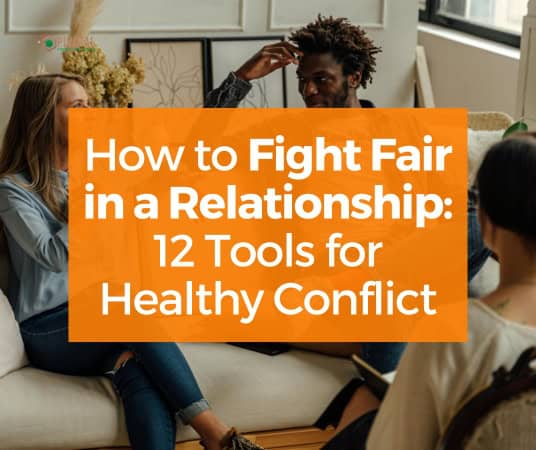
Fighting fair means addressing disagreements respectfully, listening actively, avoiding personal attacks, focusing on the current issue, managing emotions, and working together toward solutions. Healthy conflict can strengthen relationships when both partners feel heard, respected, and understood.
Conflict in any relationship is unavoidable. Romantic relationships in particular–while deeply rewarding and fulfilling–can have us bumping against childhood wounds, traumas from past relationships, or other triggers that can make navigating conflict when it comes up even harder. In fact, Dr. John Gottman’s research has identified that up to 69% of all relationship conflicts are unsolvable. That doesn’t mean that relationships are hopeless and doomed to be miserable, though! It just means we need to think about conflict in a different way. Instead of trying to avoid conflict at all costs, we should instead think about how to find ways to fight fair in our relationships and maintain respect and trust for each other, even when we disagree.
Learning to navigate moments of conflict in a compassionate and productive manner is one of the key tenets of a strong relationship. That’s not to say that it’s easy, because it’s not! Most of us were taught methods of protecting ourselves when conflict arises, rather than being taught how to approach conflict with vulnerability and curiosity.
Common Mistakes Couples Make During Arguments
- Criticizing instead of expressing needs
- Becoming defensive
- Avoiding difficult conversations
- Escalating conflict unnecessarily
- Bringing up unrelated grievances
- Focusing on winning instead of understanding
The idea of “fighting fair” is meant to convey that it’s not conflict itself that should be avoided, but that there is a way to make it through conflict in a way that considers both people involved, and lays a foundation for a stronger team moving forward. Fighting fair isn’t about someone winning and someone losing, it’s about figuring out what is at the heart of the conflict, and approaching that as a team.
Part of being able to have productive conflict within relationships means having to take accountability for how you show up. No one is perfect in conflict, and missteps don’t make you a bad person. But in order to learn how to navigate conflict with your partner, rather than against them, you need to be able to understand what you’re bringing to the situation and what else may be coming up for you.
12 Ways to Fight Fair in Your Relationship
- Focus on one issue at a time.
- Avoid criticism and personal attacks.
- Listen before responding.
- Use “I” statements.
- Take breaks when emotions escalate.
- Stay focused on solutions.
- Avoid bringing up past conflicts.
- Practice empathy.
- Validate your partner’s perspective.
- Learn healthy repair strategies.
- Recognize harmful communication patterns.
- Seek support when conflicts become repetitive.
To help you learn to fight fair in your relationship, we’ve gathered 12 resources to help you show up in conflict with vulnerability and compassion:
Many times when conflict comes up in relationships, we’re actually responding to our own histories, and not what is happening in the present moment. Cultivating self awareness on your attachment style, how that impacts your ability to navigate conflict, and gaining a more compassionate understanding for what you’re feeling and why can help you show up more generously when dealing with conflict with a partner.
Learn more about attachment styles here: What are Attachment Styles
It’s also worth looking at your boundaries, how you communicate them, and if they’re functioning effectively for you. Conflict is harder to manage when we’re burned out, stretched too thin, or feel taken advantage of. Taking time to really reflect on your ability to set and enforce boundaries can be helpful if conflict keeps cropping up in your relationship.
Discover Common Issues with Boundaries & Journal Prompts to Explore Them
Part of healthy conflict is being able to explain to the other person how we’re feeling, but that’s not always easy. Many of us don’t learn how to notice and name our emotions when we’re growing up, and that’s a skill that takes practice.
Here are tips for Learning to Notice and Name Your Emotions
You might think that negative thoughts about yourself only impact you, but they can absolutely influence your relationships as well. The way you feel about yourself influences everything, and if you’re constantly beating yourself up with negative self-talk, it makes it hard to connect with you. Learning how to challenge your negative thoughts can make a big difference in your relationships with others.
Here are 6 Ways to Challenge Negative Thoughts
No one can ever eliminate conflict from their relationship entirely, but with care and intention between partners, it can absolutely be reduced. It’s important to show up as a team not just in conflict, but to lay the foundation of love, care, and trust for when conflict does show up.
Here are 8 Small Things You Can Do to Build Healthy Relationships
Learning how to effectively communicate and how to care for one another without neglecting yourselves are ways to help strengthen your relationship as it grows. Without that strength, fighting feels riskier and many of us are unable to really “fight fair” without a strong foundation.
To help, here are 3 Tips to Improve Your Communication Skills
Growth is an important part of relationships, but it’s not always clear how to grow together as a couple while keeping a relationship healthy. While there’s no guaranteed formula that will work for every couple, there are ways to work toward growth that can feel less scary than growing apart.
Explore Ways to Grow a Relationship
To have a healthy relationship, it’s important to balance shared interests and your own interests. When your identity is too wrapped up in your partner or your relationship, it can lead to feeling like you’ve lost yourself, which can lead to resentment and conflict down the line.
Here are ideas for Staying True to Yourself In a Relationship
Arguments happen–there’s no way to avoid it, and it’s actually often worse if you do! But just because conflict occurs, doesn’t mean it has to topple your relationship. There are things you can do after an argument to repair your bond with each other and feel close again.
These are 5 Things to Do After a Fight with Your Partner
When you’re overwhelmed or emotionally activated, it’s hard to make good decisions, and that can lead to doing or saying things you might regret later. If you’re feeling overwhelmed in a fight with your partner, it’s okay to take a break and get yourself to a more regulated place before you continue your conversation.
If you need it, here are 5 Ways to Calm Down When You’re Overwhelmed
Respect is key to a healthy relationship. To fight fair in a relationship, partners need to maintain respect for each and emotional safety, even when they disagree. When communication breaks down in relationships, there is often contempt and criticism to blame. Saying things you can never take back can do irreparable harm to the trust and connection you have with each other, so be careful with your words.
Avoid harming your relationship with these Things to Never Say to Your Partner
You can learn how to show up compassionately–wanting to hear your partner’s experience to better understand them, rather than just waiting for your turn to say what happened. Making space for one another’s experiences and feelings doesn’t have to mean one person wins and one person loses–it can actually help you both win by giving you the chance to understand each other better.
How to Understand Your Partner’s Feelings
Frequently Asked Questions About Couples Conflict
What does fighting fair mean in a relationship?
Fighting fair means resolving disagreements respectfully while maintaining emotional safety and mutual respect.
Is it healthy for couples to argue?
Yes. Conflict is a normal part of relationships. Healthy conflict can improve communication and strengthen emotional connection.
How do I stop the same argument from happening repeatedly?
Repeated conflicts often stem from attachment wounds, unmet needs, unresolved emotions, or ineffective communication patterns. This is often known as the negative cycle in Emotionally Focused Couples Therapy, and all couples experience it. There are ways to learn to spot this cycle and defuse it instead of letting it spin out of control over and over. A couples therapist can help with this.
What should you never do during an argument?
Personal attacks, contempt, name-calling, threats, stonewalling, defensiveness, and bringing up unrelated past mistakes can make conflict more damaging. Criticism, contempt, stonewalling, and defensiveness are so harmful to relationships that the Drs. Gottman refer to them as the “Four Horsemen” that can predict the end of a relationship.
When should couples seek counseling?
Couples counseling may help when conflicts become repetitive, communication breaks down, trust is damaged, or emotional distance develops. If you’re ready for a change in how you relate to one another, or you feel like you’ve tried everything and nothing is shifting, a couples therapist can help.
Key Takeaways
- Conflict is normal in healthy relationships.
- Fighting fair means maintaining respect during disagreements.
- Effective communication skills can reduce recurring conflict.
- Repair attempts and empathy help strengthen relationships.
- Couples counseling can provide additional tools when conflict feels stuck.
Are you looking for support when it comes to conflict in your relationship?
Pivotal Counseling Center has therapists who work with couples and specialize in couples counseling and relationship issues. We have locations in Woodstock, Illinois, Lake in the Hills, Illinois, Elgin, Illinois, and offer online counseling throughout Illinois. If you are in need of someone to help, please consider giving us a call at (815) 345-3400.
Pivotal Counseling Center is now accepting Medicaid including Blue Cross Community Medicaid, Meridian Medicaid, and Molina Medicaid for outpatient counseling.